A visit to Bovington Tank Museum

The entrance to the main hall of the Bovington Tank Museum

For me, a highlight of our family vacation in England was a visit to the tank museum in Bovington.  Somewhat off the beaten path Bovington is the armor (armour) school for the British Army and the site of the largest collection of tanks I’ve ever seen — and most of them have been repaired to working order.  We modified our agenda to make sure we were in Bovington on a weekday when they perform a tanks-in-action demonstration.

A model of DaVinci's tank in the queue to get into the exhibits

The museum is actually a series of buildings, but we only had time for the main building.  We did not go over to the conservation building where they repair tanks to working order.

The displays begin with a depiction of life in the trenches in WWI.  This helps motivate the need for the tank to help break the stalemate in the trenches.  This section of the museum then depicts the development and evolution of early tanks into the early 1930s.  There were several WWI tanks that you could walk into or where sections of armor were replaced by plexiglass windows to enable you to look inside.

Sam and Tom coming out of a trench
A British Mark IV or Mark V tank

This hall was very dark, so many of the pictures are a bit blurry.

An early tank with a cutout to allow people to look inside. They said that this tank is in running order. Many of the tanks had oil drip pans under them -- an indication of which were still able to run.
Tom and me in the Royal Tank Corps -- and my patient wife wondering how long she was going to have to pretend she was interested in tanks before we could leave

After viewing the WWI section, we went outside for the Tanks-in-Action demonstration.  They drove four armored vehicles around a track, which included a hill.  Each stopped in front of the audience so that the narrator could provide interesting information about each vehicle.  The Tanks-in-Action demonstration naturally focused on British vehicles.  The same type of demonstration in the US that focused on US vehicles would likely be criticized as jingoistic, because only in the US is it insensitive to highlight our accomplishments.

A Cold War era Ferret armored car. This was very fast and incredibly quiet. I had seen Scorpions and Scimitars before and even had a chance to climb around inside one with the crew, but I had never seen a Ferret before.
An FV-234 armored personnel carrier. This vehicle is strikingly similar in design to the US M-113. The FV-234 is still in service.
The Chieftain main battle tank. This Cold War era vehicle never fired a shot in anger and is no longer in active service.

After showing these three vehicles, they set up a mock battle involving these three fighting insurgents from Ruritania equipped with a Saladin reconnaissance vehicle.  The Ferret conducted reconnaissance to find the Ruritanaians and called in artillery, complete with pyrotechnic devices that were a crowd pleaser.  Then the Chieftain and FV-234 advanced.  Volunteers from the audience de-bussed the FV-234 and assaulted the Saladin, winning the day.  It is not considered insensitive in England for the British to root for themselves and to defeat the enemy.

The "Ruritanian" Saladin reconnaissance vehicle

After the tanks-in-action demonstration (and some pasties and cider) we went back into the main building to look at the displays.  The hall depicting the evolution of the tank is breathtaking and includes a number of displays I have never seen in person, like the D-Day wading device on a Sherman tank.

A panoramic shot of the hall showing the evolution of tanks from WWI to nearly the present day
Another view of the history of the tank hall
A French Char B tank

Each vehicle on display has a nice plaque next to it that describes the tank and also where this particular example of the tank came from.  Some of the vehicles had a very interesting story behind how they came to Bovigton.

German Pz II tank

There are over 300 tanks at Bovington.  It is mind boggling.  I couldn’t see everything and read everything if I had two full days there.  I MUST go back when I am not pulling the family along.

German Panther tank
British Crusader tank

The US Army made many bad choices over the years regarding the extensive collection of armored vehicles on display at Aberdeen Proving Ground.  The collection is now scattered and no longer available to the public.  Even in its heyday the APG collection was open to the elements and deteriorating.  It was amazing to see such beautiful specimens at Bovington.  Some are claimed to be the only known example in the world.


Tom in front of a Pz III
A Sherman Firefly along with obligatory derogatory comments about US tank design in WWII
German Tiger I in the "Tiger Hall," where they have one example of each Tiger variant except the Sturmtiger.
A US M-46 Patton tank. The M-46, 47, and 48 were all called "Patton"
Sam in front of a cutaway view showing the interior of a tank

This was a particularly interesting exhibit showing the interior of a tank.  The kids were very surprised at how cramped it is inside a tank.

The other half of the tank
Another view of the history-of-the-tank hall

There were a number of simulators set up around the exhibit hall.  There were ones for rifles, a Bren gun, and even a PIAT.  Sadly the PIAT simulator was out of order, but in these next two pictures you see Sam and Tom firing a simulated Bren.  Neither of them “qualified.”  Both commented on how hard it is to aim the Bren with the site offset to the side because of the top-mounted magazine.

Sam firing a simulated Bren. If you look in the background of this picture you can begin to get a sense of scale for just how big the exhibit hall is.
Tom firing the Bren simulator

There are over 300 vehicles at Bovington.  This does not include all there other items on display like anti-tank weapons, comparisons of barrel lengths, tank crew equipment, etc.  While the story of the tank hall tells a story of the evolution of the tank, the largest hall is just filled with row after row of vehicles and other displays.  It is amazing!

A view of the largest exhibit hall that I hope provides a sense of the sheer size of the collection.

Bovington was the only item on my must-see list for this trip to England.  I am very glad we went.  All the items on display are extremely well maintained.  Every vehicle has informative plaques.  Many still run.  Everything is under cover.  It is tremendous museum.  I need to try to talk a couple of my gaming buddies into coming here in June next year for Tank Days, when many of the vehicles are driven around and members of the public get a chance to get into some of the vehicles and drive them.  I have driven modern US armored vehicles, like the M-1 Abrams and M-2 Bradley, but I would love to drive one or two of the historic tanks.

A final view of the large exhibit hall

Despite starting the day at a QuikFit to replace the tire on our rental car, a harrowing drive through goat paths led by our GPS and dodging a farm tractor, and a need to depart Bovington early enough to arrive in the Peak District before dark, I had a great time at Bovington and NEED to return for another visit.

Combat Patrol(TM) South Pacific Battle Report

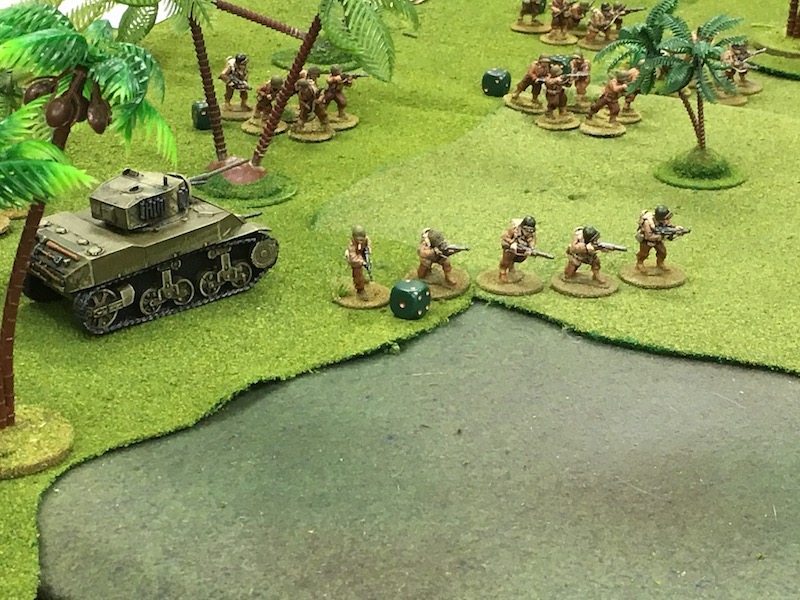
The game begins with the Americans deciding to shift their forces and mass on their left.

Last night at our club, I ran a Combat Patrol(TM): WWII South Pacific game using the rules from the soon-to-be-released supplement.  It was a chance for a final play test of some of the rules before the release of the supplement in a couple of weeks.  In particular, I wanted to test the vehicle-mounted flamethrower rules.

In this scenario, the Japanese held a string of bunkers in a jungle area.  A U.S. Army platoon with a man-pack flamethrower and a Stuart flamethrower tank attacked to seize as many of the three bunkers as possible.  The Japanese had a slightly under-strength platoon with an attached anti-tank gun and a medium machine-gun.  They also occupied three bunkers and two sand-bagged emplacements.

Seeing that the Americans were shifting, a team of Japanese advances to outflank the American attack.

The Americans wisely decided that they should mass on one flank or the other, rather than attacking on a broad front.  This left the Japanese anti-tank gun with few targets during the game.  They might have gotten off a shot later in the game as the Americans advanced across the open area, but by then the Stuart had been knocked out.

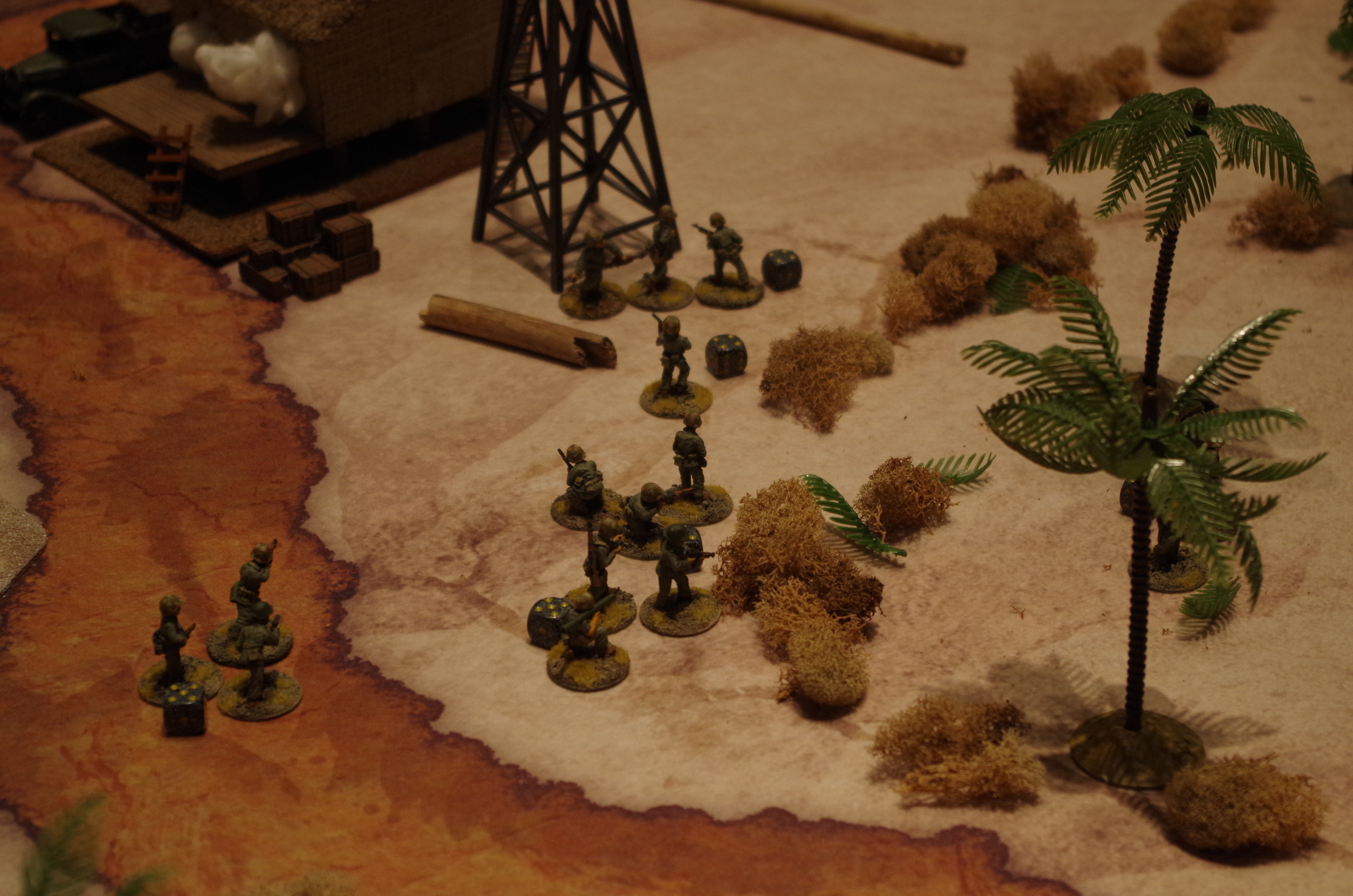
After a bit of a slow movement, the Americans reached the edge of the jungle and prepared to advance across the open ground to the Japanese bunkers.

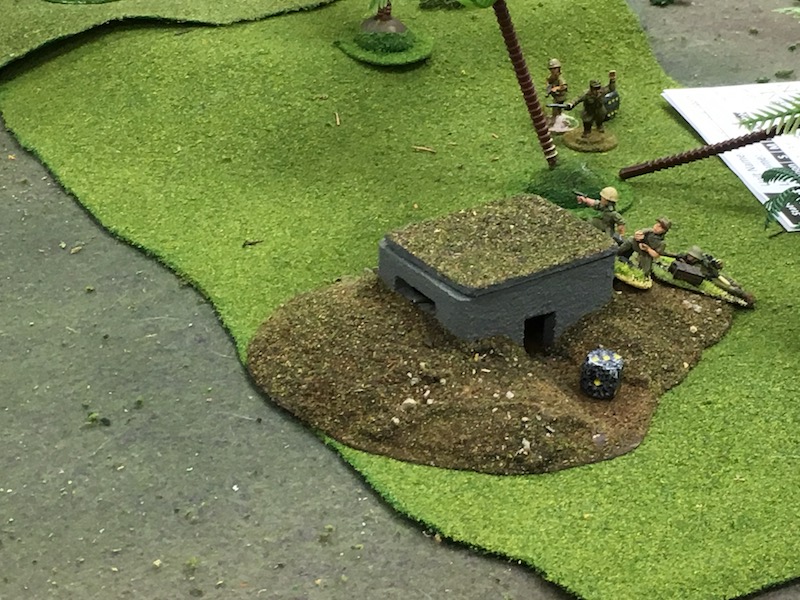
The Americans reached the edge of the jungle and were preparing to dash across an open area toward one of the Japanese positions.  The first unit at the edge of the wood line was an American .30 cal machine-gun team, but before they could get it set up, they began taking effective fire from Japanese infantrymen in their right-most bunker.

The American machine-gun team was knocked out by rifle fire from one of the Japanese bunkers.
A bunker at the edge of the jungle. I don't have any log bunkers yet, so I had to use these ETO-looking ones.

Seeing that they were being flanked, another Japanese team advanced from their original positions into a small jungle area in the middle of the table.

A Japanese team advances to interfere with the American attack. The sandbagged position protects the Japanese medium machine-gun team.

At this point the Stuart reached the edge of the wood line and fired on the Japanese machine-gun team in the sandbagged position.  This was extreme range for the flamethrower.  Two members of the machine-gun crew were killed in this attack.

The Japanese infantry team that advanced in the previous picture was equipped with a lunge mine.  The South Pacific supplement includes a rule for Japanese suicide anti-tank attacks.  The soldier with the lunge mine and another solider charged out and attacked the Stuart.  The attack was successful.  The player drew a card to determine where the tank was hit (the side of the hull) and the amount of penetration.  Receiving a penetrating hit, the Japanese drew one more card to determine if the vehicle brewed up.  It did.  So after just one shot, the flame thrower tank was knocked out.  Because this was an intentional suicide anti-tank attack, the Japanese figure became incapacitated immediately, but his unit did not accrue a morale marker.

The Stuart is knocked out by a lunge-mine suicide attack.

As the flamethrower tank was their most important weapon for reducing the Japanese-held bunkers, things began to look grim for the Americans.  Fortunately they still had a man-packed flamethrower and some hand grenades.

Teams of American infantry advance.
The Japanese in the right-most bunker with the roof removed. This was the focus of the American assault.
The center of the table became a fur ball.

The remaining member of the machine-gun team fired a few shot before running out of ammunition.  Although the Stuart was knocked out early, the fact that it suppressed the machine-gun team enabled the Americans to cross the open area with few casualties.  The remaining member of the machine-gun team put up a good fight for a couple of activations, but eventually the Americans incapacitated him and moved past this position to get behind a Japanese bunker.

A closeup look at two Japanese in a small sand-bagged emplacement

About this time the Japanese realized they were out of position and needed to close with the Americans to slow their advance and keep them away from the bunkers.  They declared a Banzai charge.  In Combat Patrol(TM), there is a nice balance in Banzai charges so that they are interesting and effective without being too powerful.  Once the charge begins, the Japanese draw two action cards for movement rather than one, giving them much greater speed; however, they do not receive any benefit of cover.  The charge continues until a card is drawn from the Activation deck ending it.  This could occur in the next turn or several turns later.  The Japanese accrue morale markers, but they do not resolve them until the Banzai charge ends.  In this game, the card ending the charge was drawn as the first card of the next turn, ending the charge earlier than expected.  Still, it had the desired effect:  the Japanese had closed with the Americans and slowed their advance on the bunkers.

In the meantime, the man-packed flamethrower advanced on the rightmost Japanese bunker, but when his team was taken under small arms fire, the operator was incapacitated.  The Americans then made an attempt to drop a grenade into the bunker, but failed.

After overrunning the Japanese machine gunner, the Americans swarmed past this position and prepared to get behind two of the enemy bunkers.

At this point it was getting late, and the American attack had been spent.  I declared the game a Japanese victory.  It was a very fun scenario, and all agreed we need to try it again soon.

Air Ship for Pulp and VSF Games

A long shot of the zeppelin

Some months ago I succumbed to the lure of this really cool MDF air ship kit.  I have been staring at the stack of MDF, cardboard, and other bits for months.  Finally last weekend my daughter and I began to assemble it.  During the week we began to paint the various sub assemblies.  While I was gone for two days on business she completed the final assembly.  Storage problems aside, this is a very nice kit and will make for some very fun Pulp and VSF games.

A view of the bridge through the front wind screen

I staged a bunch of my Pulp figures on the air ship to shoot some photos.

The action toward the bow of the airship

The airship kit was from Rusti at Crossover Miniatures:  http://crossoverminiatures.com

A slightly longer shot from the bow

This airship is in five sections: the bow, a passenger section, a cargo section, a stern section, and cone to finish the stern.

The bridge from inside the airship


She Wolves charge across a gangway
A view into the cargo area from the stern

Cub Scouts defend the stern of the airship

You can see some alligator clips holding sections together.  The kit comes with mount points for magnets.  I have to purchase some and glue them to the ship, but for now, I’m using alligator clips.

German zeppelin troopers advance into the passenger area
Bad guys involved in nefarious activities in the dining room

The state rooms
American rocket troops defend the airship from Germans on pterodactyls
The clear plastic disks to suggest a spinning propeller came with the kit
A final look

I think this will make a great centerpiece for a series of Pulp or VSF games.

My daughter did a terrific job with final assembly.  I am anxious to get it into a game soon.

The Retreat from Moscow

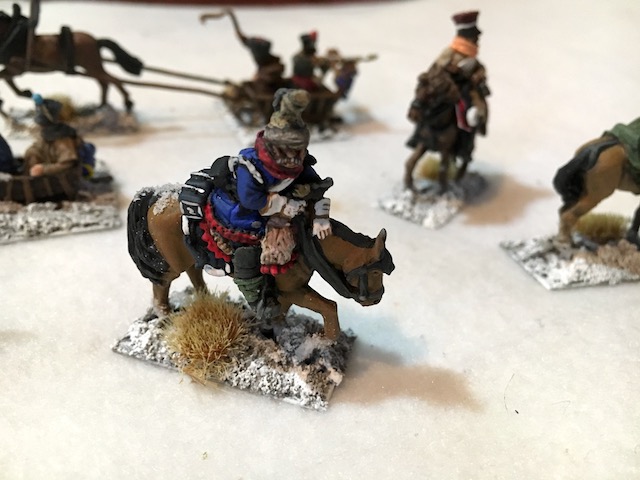
I have been working for over a month to complete a batch of Retreat from Moscow figures.  These were a Christmas present two Christmases ago.  They took a very long time to paint, because each one was a different, so I couldn’t really paint them by assembly line.  I think they came out nicely.  What do you think?

The figure of New in the center foreground was a free giveaway figure at Historicon some years back.

We should see these in a Combat Patrol(TM) Napoleonic game soon…

I created the snow effect by covering the bases with a coarse medium gel.

I coated the bases with this coarse pumice gel, which dried in a gray color.
This is what the bases looked like after the coarse pumice medium gel was applied.
Once the gel dried, I then dry brushed the bases with white and applied some winter grass tufts.

Downed Plane

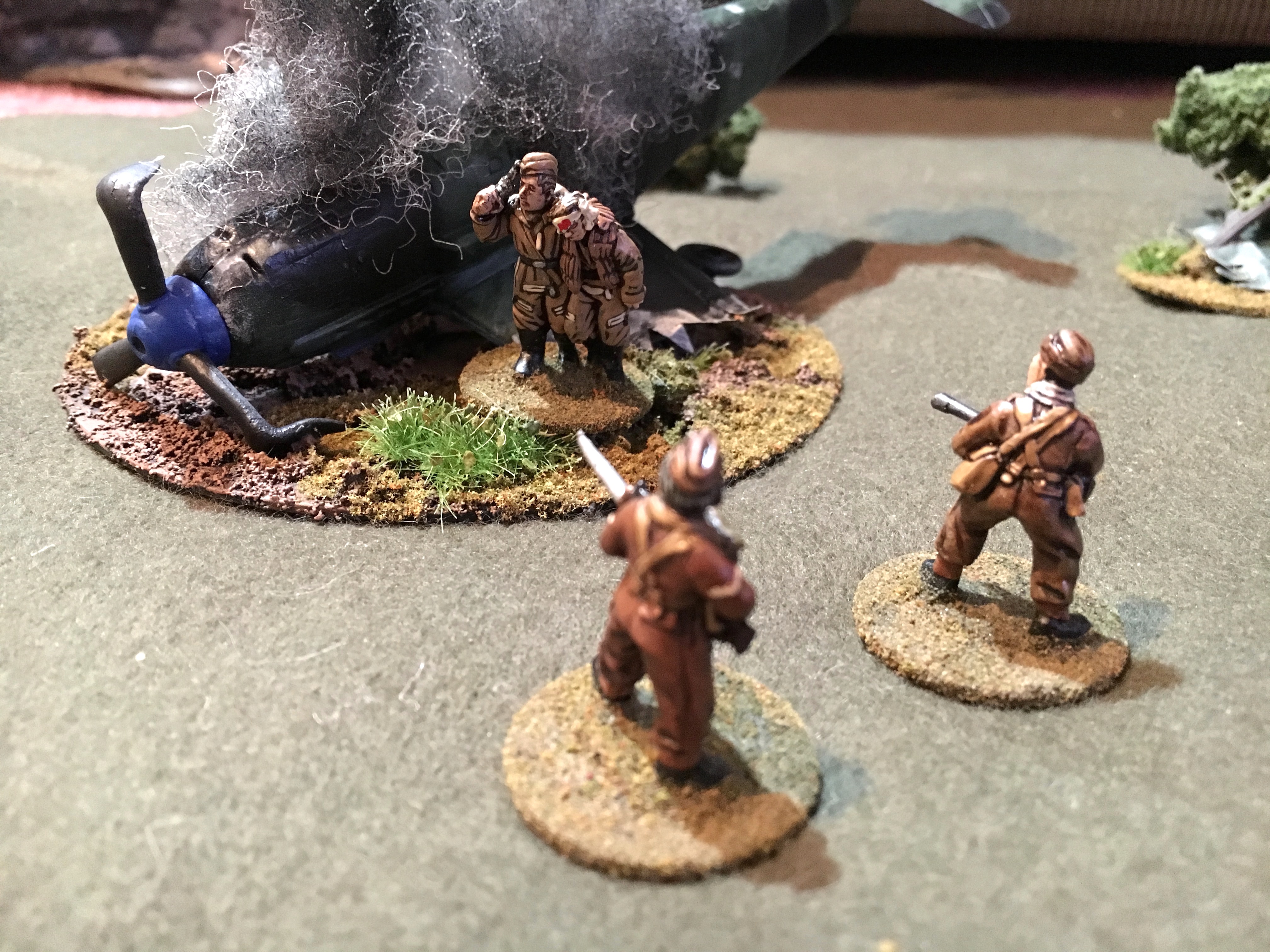
A downed pilot captured by two members of the Home Guard

I recently completed building a downed German fighter plane for a WWII skirmish game.  The plane was a cheap ($13) snap together kit meant for kids, but it was 1:48 scale.  The crew and the Home Guardsmen are Foundry.

A view of the wrecked plane, including the wings that have ripped off.

Rather than a single, large base, I decided to make the plan on three smaller bases.

Combat Patrol(TM) South Pacific Supplement is Almost Done!

I completed the South Pacific master cards today. These are for the South Pacific supplement to Combat Patrol(TM). I have sent them to DriveThru to do their magic to make the cards ready to print. At that time, I’ll send the revised masters to Sally 4th to get ready to print them in the UK. Soon afterward players will be able to purchase the cards from either DriveThru or Sally 4th. I have one more item to play test in the South Pacific supplement, vehicle-mounted flame throwers, and then it will be ready to go.
Why is there another set of cards? The vast majority of the rules are unchanged. There are a few new items in the free supplement, like Banzai charges, infiltration tactics, incapacitated Japanese lying on armed grenades, and die-in-place missions. This supplement is for the South Pacific, which had a very different tenor than other parts of the Pacific. One thing that came out in play testing is that the normal morale rules don’t seem very “Japanese.” These new decks have more unit-level morale results and fewer individual-level results. In play tests people felt that the new morale results seemed to represent Japanese behavior better.
There is a table in the supplement that can be used to cross index the card serial number from the 10 original Action Decks to find the Japanese morale result. I figured that people would get tired of that after a while, so there will be two new Action Decks just for Japanese units. You don’t NEED the new decks, but they will make life better if you play games set in the South Pacific. So the decks are finally done and ready to go to print. That should happen before the end of the month.

Award Winning HAWKs at Historicon 2017

Geoff, Chris, Don, and Eric, HAWKs who won awards at Historicon 2017

We had four HAWKs win awards at Historicon 2017.  Geoff won an award for this Lego pirate game for kids.  Chris Johnson won an award for his American Civil War game for kids.  Don won an award for his Battleground WWII game on our French village table.  Eric won an award for his American Civil War game for kids.

Congratulations!

Combat Patrol Games Run at Historicon 2017

There were several Combat Patrol(TM) games run at Historicon 2017.

French vs. Italians 1940

The first was a Thursday game run by Eric Schlegel set in southern France in 1940.  It involved the Italians attacking the French.  I only managed to get one poor picture of this game.  You can see that the Italians had to advance across open ground to get to the French positions or slog through the woods.  Despite some success on the Italian right flank, the game was judge a French victory.

Italians attack French positions in 1940.

The Bocage

I then ran two bocage games on Friday.  Don and I set up the bocage table and then ran three games on it.  I ran Combat Patrol(TM) in the morning and evening.  In the afternoon Don used to table to run a game using “brand X” rules (Battleground WWII).  In both of my scenarios the Germans were allowed hidden setup, and the Americans were tasked to clear the road.  Unfortunately I was busy running the game and didn’t remember to take very many pictures.  The ones I have don’t tell a coherent narrative, but you can at least see some eye candy.

An American halftrack has a bad day.
Germans along a hedge row managed to knock out one or two American vehicles and withstand some infantry close assaults.

After the first scenario, every US vehicle had been knocked out, and the Germans had taken few casualties, so it was a decisive German victory.

Don's "brand X" game on the bocage table. This is the only long shot I took of the table that he and I used all day.
American halftracks advancing during the second running of this scenario. The Pz II survived to the end of the game despite a jammed turret and repeated infantry close assaults. The Americans attacking the Pz II had no anti-tank weapons, so they were forced to try to throw grenades in the hatches, which is tricky business.
A longer shot of the American advance
The Sherman advances and the Pz. II drops back under close assault from American infantry.

The first running of this scenario was a decisive victory for the Germans.  The Americans attacked across a wide front, weren’t very aggressive, and never were able to mass on a decisive point.  The second instance was much closer.  The Americans massed on the German right flank and enjoyed initial success.  Then they got bogged down fighting for the farm house in the center of the table rather than bypassing it.  The game was a marginal German victory.

Action around Pomme du Terre

We then set up a French village, called Pomme du Terre, and ran four games on it to amortize the effort of laying out all the buildings.  We ran three Combat Patrol(TM) games on the terrain and one with “brand X.”

The town of Pomme du Terre being set up for four scenarios. The town is almost exclusively Crescent Root buildings with a Sally 4th corner cafe and flagstone road, and Battlefield Terrain Concepts trees.
Another view of the town

1918

Duncan used the town for Germans vs. Americans in 1918.  I was running one of the bocage games while this game was going on, so I only snapped two quick pictures.  Apparently the American platoon was pretty badly shot up trying to take the town from the Germans.

In these pictures you can see that Duncan uses flat disks from Fantasy Flight Games to mark morale checks.  You can also see that Duncan printed unit cards with colored circles on them.  These circles corresponded to colors on the figures’ bases and made it easier for players to figure out which troops were theirs when the fighting got close.

1940

Saturday morning I ran a German assault to capture Pomme du Terre from the French in 1940.  The French were supported by an AT gun and three FT-17s, only one of which was equipped with a gun rather than a machine-gun.  There Germans were supported by two Pz. II’s

German infantry advances to the outskirts of the town.
Advancing German armored support
Close cooperation between German armor and infantry. In this picture you can see the command dice on the units that are used in the Double Random (TM) activation mechanic used in Combat Patrol (TM).

The Germans advanced steadily through the town but then got bogged down trying to clear the town square.  Had they advanced around either flank, rather than right up the middle, they might have gotten to the French AT gun and cleared the road.  The result was a French victory.  All the players seemed to really enjoy themselves.

1944

My second game in Pomme du Terre was an American attack on the town.  It was more of a meeting engagement as the Germans weren’t prepositioned in the town, but the onus remained with the attacker to clear the road.  The Germans had a Panzergrenadier platoon with halftracks, two Pz. IV’s and a Marder.  The Americans had an armored infantry platoon with halftracks, a Sherman, an M-10, and a Stuart.  The Americans had a bazooka as well as several captured Panzerfausts.  The forces were of roughly equal size.

The Sherman advances

The Germans lost a Pz IV early in the game from a shot from the M-10.  The Marder was knocked out by a long-range bazooka shot.  On the other side of the table, the Germans got THREE shots off at the Sherman but rolled very poorly and didn’t knock it out.  They did damage the main gun, turning it into a mobile machine-gun platform.  The Americans handled their vehicles aggressively.  The combination of the Sherman, M-10, and Stuart kept the remaining German Pz. IV busy but didn’t knock it out by the time the game ended.

Marder knocked out by a long-range bazooka shot

Both the American and German infantry advanced into the town and got into close quarters combat in and around the town square.  Despite heavy casualties, neither side managed to get a clear upper hand.

The Sturt and a halftrack advance through the town

A funny moment came when, after the left-flank Pz. IV was knocked out, an American halftrack dashed around the flank, dodging Panzerfaust shots, and circled behind the Germans.  Big surprise for Herman as their infantry started taking fire from three directions.

Though the Germans didn’t knock out any US vehicles, they did knock out the 75mm gun not he Sherman.  The objective was for the Americans to control the road through town.  They didn’t manage to do this by the time the game ended, so we called it a marginal German victory.

We had one player who struggled to get his head around the card mechanics of Combat Patrol(TM) and another who wanted to argue the ratings of guns and armor for some of the vehicles, but otherwise the weekend was a big success.  Many new players had a chance to try Combat Patrol(TM), and several went down and bought copies from the dealer hall — or at least said they did.   I also had quite a few players who came back from either previous conventions or from previous games this weekend.  Every one of my games was completely full, and I even added a couple of extra players who really wanted to try the rules.


HAWKs run Games for Kids at Historicon

As usual, the Harford Area Weekly Kriegspielsers ran several games focusing on kids at Historicon.  Below is a quick rundown on some of them.

Navies for Kids Giveaway

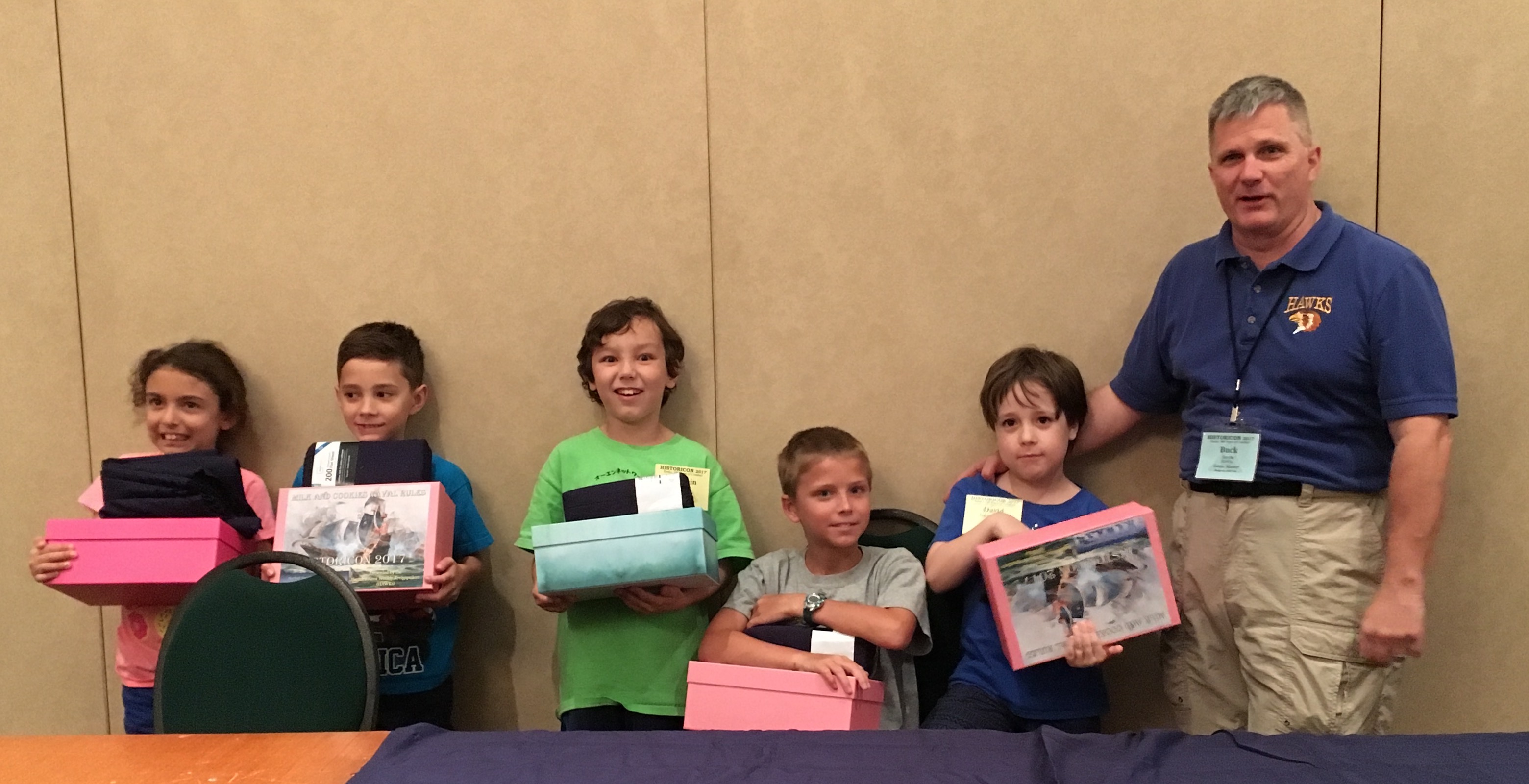
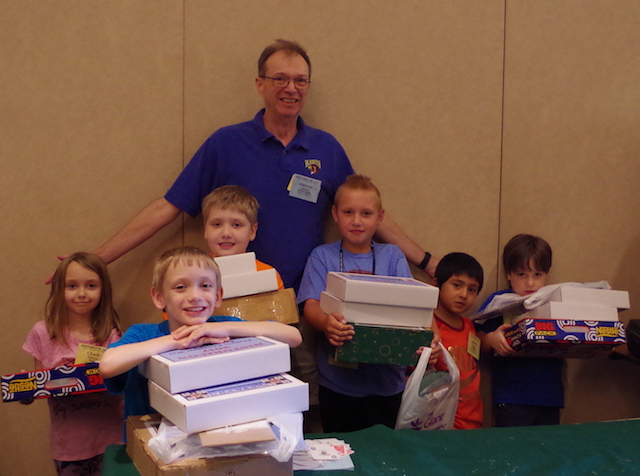
Buck Surdu ran a game in which a group of kids were given a box full of boats and other materials.  They then chose sales for a stack of patterns and colored them.  Then we helped them hot glue the sails to the masts.  With a set of rules designed for this game, we ran a naval action pitting side A against side B.  When the game was over, the kids took hope their two decorated boats, two more the assemble, rules, dice, measuring sticks, a sea cloth, and everything they would need to run the game at home for their buddies.

Some of the kids inspecting their supplies
Decorating sails
Getting help to hot glue the sails to their masts
Waiting patiently
The game in full swing
The kids and their loot

Armies for Kids Giveaway

We worked all year through a series of club painting days and other events to build six complete sets of armies (one French and one Prussian) for a 15mm Franco-Prussian War giveaway.  As in previous years, the kids played the game and then each went home with a French Army, a Prussian Army, terrain, dice, tape measures, and a ground cloth.

Some of the kids playing the FPW game
Another view of the game in progress
Duncan puts a set of figures back together after the game.
Putting sets together to hand out to the kids.

Santa Duncan hands out loot
Duncan and the six lucky kids

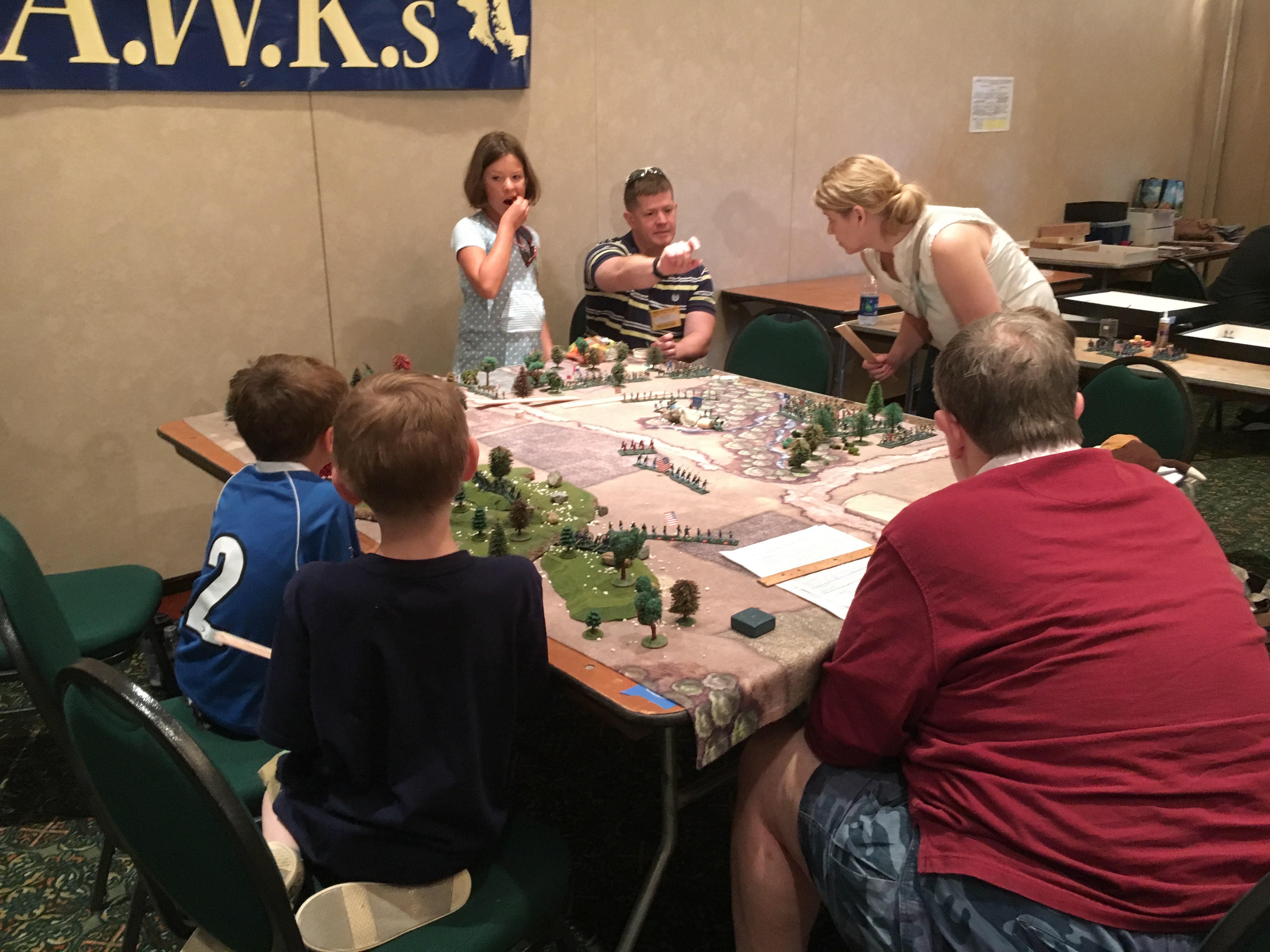
Chris Johnson’s Award-Winning ACW Kids’ Game

Chris was presented an award from the convention staff for this kids’ game.

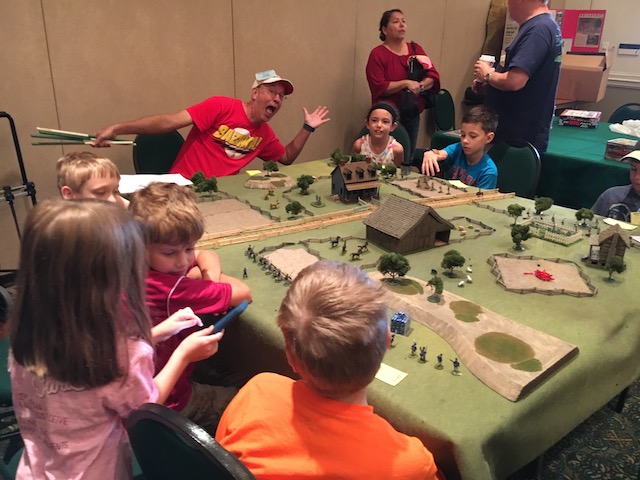
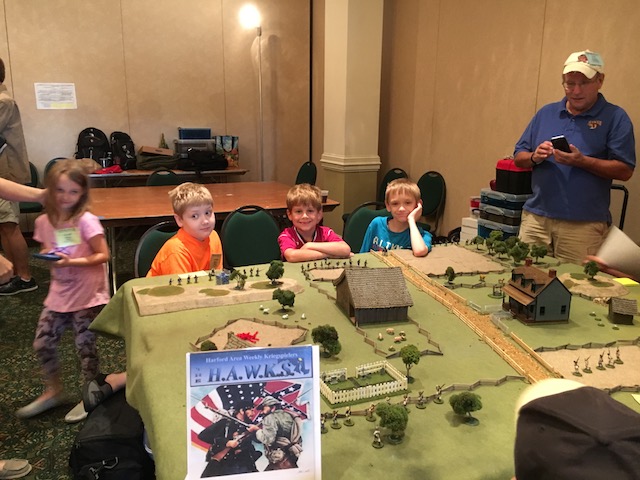
Eric Schlegel’s Award-Winning ACW Kid’s Game

Duncan Adams’ Lionheart Game for Kids

Geoff Graff’s Award-Winning Lego Pirate Game for Kids

This has been a perennial favorite in the HAWKs rooms for many years.  Geoff never fails to keep the kids entertained and engaged!

The game gets under way.
You can tell that Geoff enjoys these games as much as the kids
A boat full of Lego pirates. The ship comes apart to reveal the lower decks.


The answer to my question, "Who had fun?"
A happy Geoff and some happy kids -- or maybe that's redundant...