Book Four in the Series Underway

I finally got past the writer’s block I’d been experiencing for weeks.  I’ve now written the first couple of chapters.  I had a large stack of 3×5 cards, but I struggled to get started.

What I did to break the block is to write one character’s story arc.  One of the supporting characters in my Frank and Sylvia Mysteries is Ruby Sue.  She has a crisis of faith in the fourth book.  I wrote all the sections of the book regarding that crisis of faith.  That pulled the finger out of the dike, and now I am moving forward.

I’m not sure I’d recommend this for everyone, but here is my technique.  I had decided who the villain is, and his motivations.  I had decided on how the mystery would unfold.  I had a stack of 3×5 cards with notes.  I knew how the main characters would solve the mystery, but I couldn’t get started.
In the third book, I was in the same position.  The Chicago crime boss whose rackets my main characters broke up in the first two books was going to trial and wanted to kill Frank and Sylvia so they couldn’t testify, so he put out an “open contract” to have them killed.  So it was first come first paid.  Several hitmen (and a few red herrings) came to town.  But I couldn’t get started.  So I wrote each hitman’s and red herring’s arc from beginning to end: how and when they came to town, how they tried to kill my protagonists, how they failed, etc.  Soup to nuts.  Then I wrote some other scenes, like when Sylvia and her friend Ruby Sue enter contests at the county fair.  Finally, I started to weave these together: scene with hitman 1, scene with red herring 2, etc.  In doing so, I had to rewrite many parts so the characters didn’t know things they shouldn’t have known yet.  Writing the arcs began to fill the blank page.
In the fourth book, I knew that I wanted Ruby Sue to have a miscarriage, leading to a crisis of faith.  I had much of that arc in my head, so I wrote it.  It consists of about six sections that I’ll later interleave into the manuscript in the right places.  It got me writing.
I also used Google Maps AI to help with an issue.  I needed a place where five landmarks would be visible in 1955.  They aren’t all visible from one place today, but Google Maps helped me find one in the book’s time period. In the fourth book, I now have a vantage point to see the five landmarks, which is key to Frank and Sylvia solving the mysteries.
I know the community is death on AI — and whether someone will falsely accuse my books of being written by AI keeps me up at night — but CoPilot is an excellent research assistant. I haven’t used AI to WRITE anything, but it is a good research assistant. It helped me understand counterfeiting in the 1950s.  But it makes mistakes, and I caught one when it said that thermographic ink was used to prevent counterfeiting.  I questioned that, and CoPilot admitted that thermographic ink wasn’t invented until the 1970s.
So, I guess, my general advice is to write what you know will be part of the story, even if you don’t have everything worked out yet.  It fills the blank page.  Some of it may be heavily edited or even thrown away later.  I have an initial draft of 18,000 words.  My other three books are in the 85,000-word range.
In the fourth book, Mrs. Crabtree, their teacher, is attacked.  Frank and Sylvia, along with Nick and Ruby Sue, set out to find her attacker.  The story will have some interesting twists along the way.

Meanwhile, I am continuing to tinker with the first and second books.  The first has been professionally edited and picked up by a small traditional publisher.  I plan to send the second book to the editor in December.

I Signed a Publishing Contract for my Debut Novel

I just signed a contract with WordCrafts Publishing for my debut novel.  It is a clean-read, semi-cozy mystery set in a small coal-mining town in Illinois in 1954.  It is very exciting to find a publisher, and WordCrafts are great people.  It is now in the production pipeline, due for release in hardcover, paperback, and Kindle in late 2027.  Sixteen months seem like a long time, but that is actually very fast.

I am Witing a Novel

Recently, we moved from Orlando to a small town east of Knoxville, TN, into what we hope is our forever home.  I have a long list of things to accomplish during retirement.  You need to retire TO something, not FROM something.  One of my goals is to write a novel.  I enjoyed creative writing when I was younger, but the past four decades have been focused on technical writing, proposals, and patent applications.

I had been thinking about this novel during morning runs for nearly 20 years.  In February of 2025, I started on it.  I had scraps of ideas and a number of plot points, but it took a while to weave those ideas into (what I hope is) a coherent, compelling story.

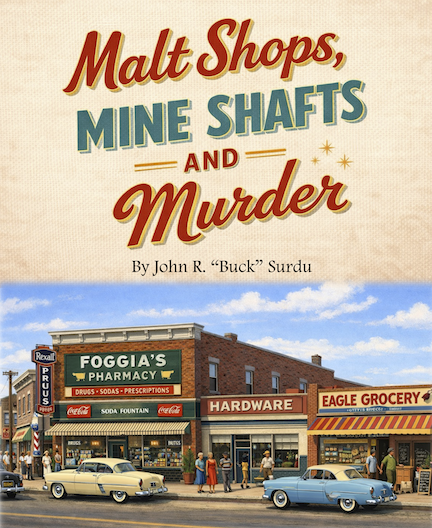
This is a cover mockup I made myself.  If the book is ever published, I’m sure it will look different.

Malt Shops, Mine Shafts, and Murder is an 80,000-word, semi-cozy historical mystery with emotional depth, clean content, and a vivid sense of 1950s small‑town life. It will appeal to readers who enjoy the warmth and community of Joanne Fluke’s Hannah Swenson mysteries.

Nineteen-year-old Frank Serafini returns to his Illinois hometown in May 1953, carrying survivor’s guilt from the Korean War and remorse for abandoning his childhood sweetheart and fiancée, Sylvia Martinelli. He hopes to rebuild his life and repair their relationship, but his homecoming is overshadowed by the recent, suspicious death of his father.

Sylvia is torn when Frank reappears. His sudden departure shattered her trust, and before she can risk her heart again, she needs to understand why he left—and whether he intends to stay.

When Frank receives a threatening phone call demanding papers his father supposedly possessed, the danger becomes unmistakable. After Sylvia’s father’s car is set on fire as a warning, Frank and Sylvia follow the clues his father left behind and uncover evidence implicating the town’s mayor in a far-reaching criminal enterprise. As the racketeers close in, Frank must confront the man he became in Korea and risk everything to protect Sylvia, expose the truth, and save the town he once fled.

This is the first in what is meant to be a series.  The second and third books are written.  I am outlining and plotting the fourth book.

I have done extensive research to ensure the story is accurate to the 1950s.  While I enjoyed Grease and Happy Days, neither is an accurate depiction of the era.

As mentioned earlier, it is clean.  There is no graphic violence, sex, or language.  As such, it won’t appeal to some.  I don’t think you have to watch guts fly out of people, gratuitous sex scenes, or foul language to enjoy a story.  But there is action, romance, and mystery.

In preparing this book for submission to literary agents, I used two different “developmental editors.”  Katherine Picket at POP Editorial Services helped me greatly improve the story.  Katherine, the second editor, was not shy about ripping into the manuscript and providing voluminous, uncomfortable notes.  I sent her a revised manuscript, which recently came back relatively clean.  I made a number of additional revisions and sent the revised manuscript to some potential literary agents.

I had an opportunity to attend the Tennessee Writers’ Conference a few months ago and pitch the story concept to three agents.  All three asked me to submit the manuscript.  One wanted just the first four chapters.  Based on those, she wanted the full manuscript, which I understand it a big milestone.  The second one read the first few chapters of the manuscript earlier this week and said she liked it.  So, perhaps the light up ahead is the end of the tunnel and not an oncoming train.  Of course, finding an agent is not the same as getting a book deal, but it would be a huge step forward.  I am allowing myself to become guardedly optimistic.

I hope the book finds an audience that will enjoy the story.  While I cannot sell ice water to men in Hell, I am looking foward to meeting with people who have read and enjoyed Malt Shops, Mine Shafts, and Murder.